I Tested the #OpenToWork Banner Again. This Third Test Had the Most Shocking Results Yet.
Third round of the #OpenToWork banner perception test. Same photo, banner vs no banner. Competence dropped 2.9 points, likability 3.0, influence 3.3. The banner is a full authority downgrade, not a cosmetic change. What your profile photo says about you before you say a single word.
Originally shared on LinkedIn: November 25, 2025
I tested the #OpenToWork banner on my profile photo again. This third round had the most shocking results yet. You may want to rethink your profile photo.
People always ask me: "Do I add the banner or not?"
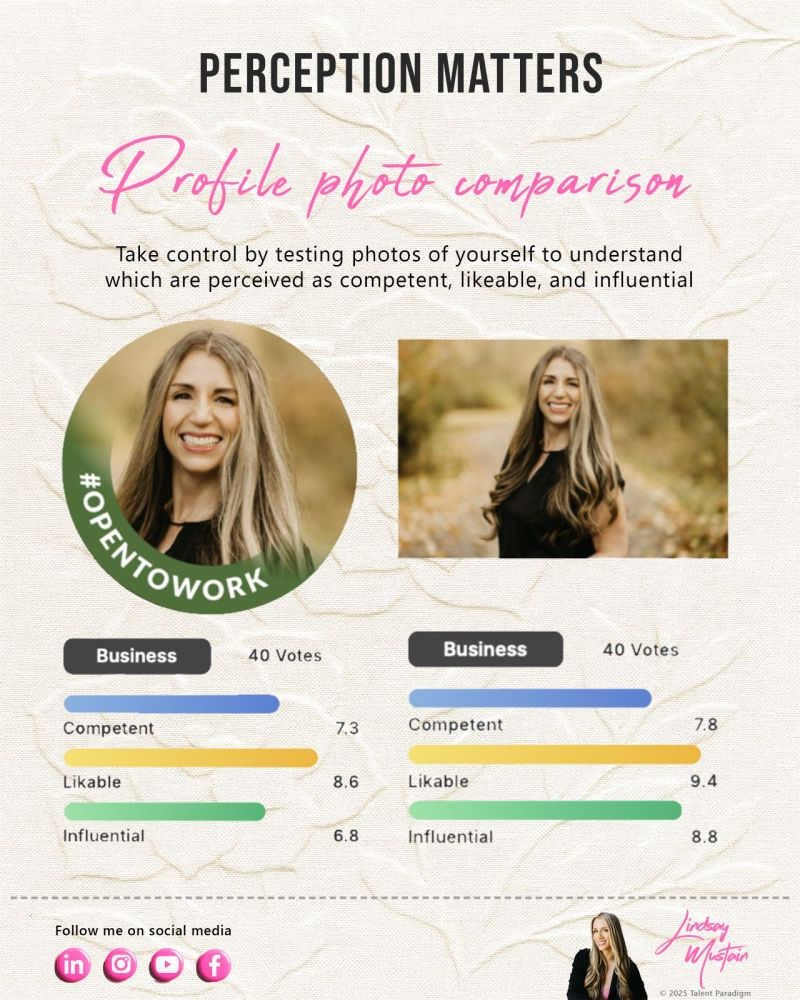
So I ran a controlled test of my photos with the #OpenToWork banner and without. The photos were judged in a controlled voting environment on three axes: Competence, Likability, and Influence.
The Results With the Banner
Same photo. Only the banner changed.
- Competence: down 2.9 points
- Likability: down 3.0 points
- Influence: down 3.3 points
A 3-point drop is not cosmetic. It is catastrophic. It is a full downgrade in perceived authority.
Influence is the perception most tied to leadership and hireability. If a decision-maker sees you as less influential in the first fraction of a second, everything downstream in your search gets harder. Your outreach lands with less weight. Your profile gets skimmed instead of read. Your referrals get quieter endorsements.
The banner did that. Not your resume. Not your track record. The banner.
This Is Called Unconscious Bias
You might think your photo does not influence perception, or you might think that it should not. Both my experiment and the underlying research say otherwise.
It is unfair. But it is a fact. And when we embrace the truth, we can take action to change it.
According to a Princeton study by psychologists Janine Willis and Alexander Todorov, humans form first impressions in one tenth of a second based solely on someone's face.1 Those snap judgments decide whether we see someone as competent, likable, and trustworthy. Additional exposure time did not meaningfully change the initial judgment. It only made observers more confident in it.
Your photo is the first thing people see on LinkedIn. It decides whether someone looks at the rest of your profile. It sets the tone for how everything else is viewed.
What This Means for Your Hireability
Inside the Theory of Hireability™, this is a Perception Anchor™ problem. Every touchpoint the market has with you is either anchoring you into the Candidate of Choice™ position or anchoring you out of it. Your photo is one of the highest-frequency anchors you own, and most senior professionals never audit it.
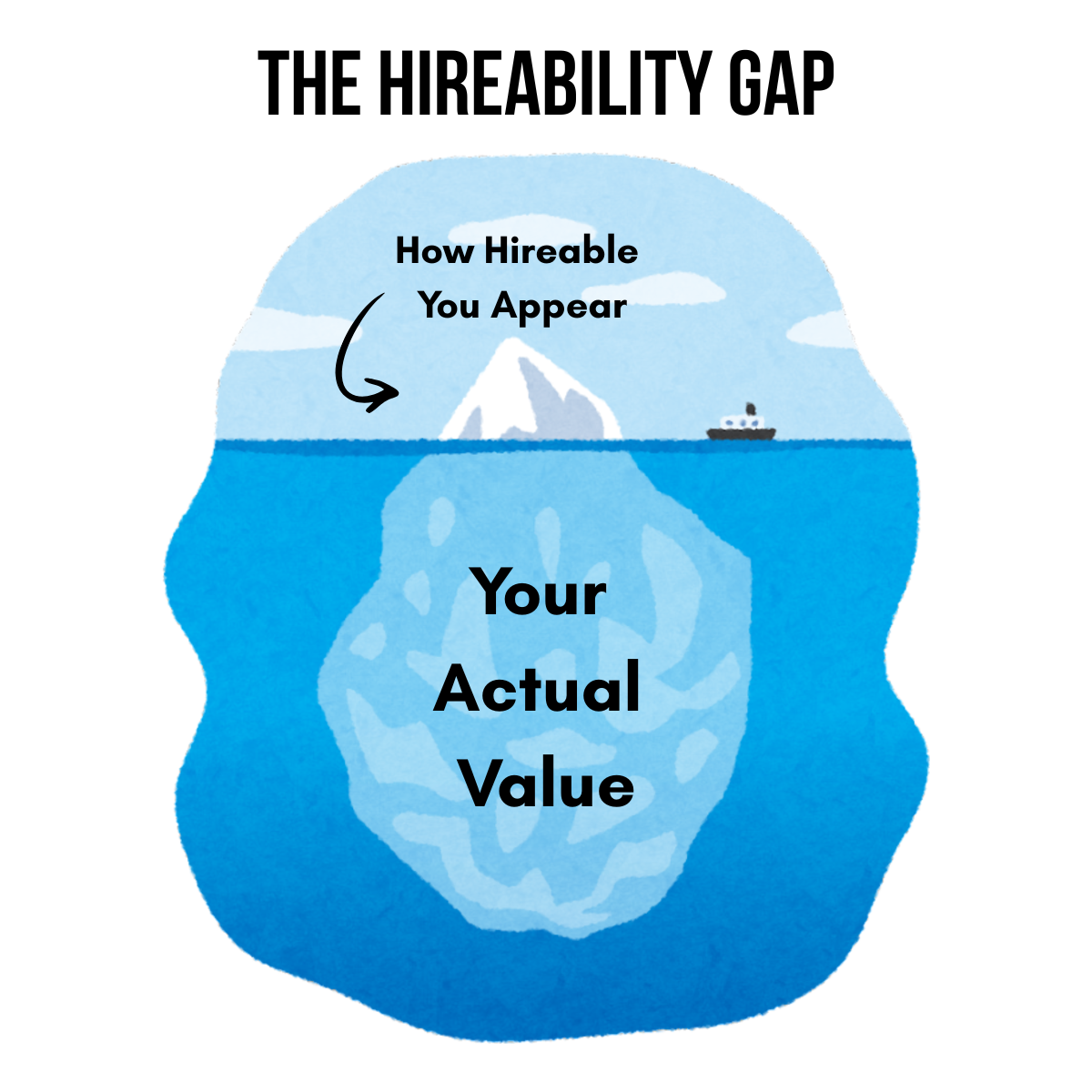
If your photo is signaling "job seeker" instead of "senior operator the market is trying to keep," you are widening your Hireability Gap™ before you say a single word.
Research on hiring stigma has also found measurable bias against candidates perceived to be actively looking versus passively signaling.2 The mechanism is the same one my experiment surfaced: a visible marker that says "I need something" reduces perceived power and authority. That perception then follows the candidate through the process.
The #OpenToWork banner was designed to help. In practice, it can also anchor perception in a way that costs you the roles you actually want.
What To Do About It
Audit your photo the way a recruiter would in the first tenth of a second. Ask three questions:
- Does this photo make me look competent at the level I want to be hired at?
- Does it make me look like someone others want to work with?
- Does it carry the authority of the seat I am targeting, not the seat I just left?
If the answer to any of those is "not really," the highest-leverage change you can make this week is your photo. Not your resume. Not your headline. Your photo.
Frequently Asked Questions
What is the #OpenToWork banner and why does it matter?
The #OpenToWork banner is a green frame around your LinkedIn profile photo signaling you are actively looking for work. It matters because the photo is the first perception anchor a recruiter or decision-maker encounters, and research shows first impressions form in about one tenth of a second based on the face alone. Anything overlaid on that photo shapes perception before your credentials are ever read.
Does the banner actually hurt candidates in perception tests?
In this third controlled test the same photo lost 2.9 points on Competence, 3.0 on Likability, and 3.3 on Influence when the banner was added. A 3-point drop in Influence is a full downgrade in perceived authority. Influence is the perception most tied to leadership and hireability, so the cost lands squarely where senior professionals cannot afford it.
Isn't visibility on LinkedIn more important than perception?
Visibility only helps if the perception attached to it is the perception you want. A visible signal that reads as "I need something" reduces perceived power. That perception then travels with you into every follow-up, every referral, and every screening call. Being visible while anchored as low-authority is worse than being quiet and anchored as high-authority.
What is a Perception Anchor™?
Inside the Theory of Hireability™, a Perception Anchor™ is any signal in the market that pulls how you are perceived toward Candidate of Choice™ or away from it. Photo, headline, banner, comments, articles, referrals, and endorsements all function as anchors. Your photo is one of the highest-frequency anchors because it appears everywhere your name does.
What should I do instead of using the banner?
Audit the photo itself against three questions: does it carry the authority of the seat you are targeting, does it look like someone others want to work with, and does it read at the level you want to be hired at. If any answer is weak, change the photo. Then rebuild the surrounding profile so the market sees you as a senior operator worth keeping, not a job seeker waiting to be picked.
Sources
Want to see whether your own profile photo is anchoring you into or out of the Candidate of Choice™ position? Start with the Theory of Hireability™ manifesto: theoryofhireability.com
Footnotes
-
Willis, J. and Todorov, A., "First Impressions: Making Up Your Mind After a 100-Ms Exposure to a Face," Psychological Science, 2006. https://journals.sagepub.com/doi/10.1111/j.1467-9280.2006.01750.x ↩
-
Kroft, K., Lange, F., and Notowidigdo, M. J., "Duration Dependence and Labor Market Conditions: Evidence from a Field Experiment," Quarterly Journal of Economics, 2013. https://academic.oup.com/qje/article/128/3/1123/1849660 ↩